Theoretical principles of flux-cored welding: Welding of low- and high-alloy materials
Flux-cored wire welding is a modern and versatile welding technique that enjoys great popularity in both industry and trade.
This training course covers the theoretical fundamentals of flux-cored welding, with a particular focus on selecting the correct flux-cored wire and setting the correct parameters. The course specifically addresses welding low- and high-alloy materials with various flux-cored wire types, such as rutile, basic, and metal powder flux-cored wire.
Flux-cored welding is a special form of arc welding in which the wire serves as both the electrode material and the filler material. The wire is continuously fed into the weld seam, and heat is generated between the wire and the workpiece by the electric arc. The flux-cored wire contains various alloying elements and is used in different versions depending on the requirements to achieve the desired welding characteristics.
- Rutile flux-cored wire
- Basic flux-cored wire
- metal powder-filled wire
This training course is aimed at welders and welding supervisors who wish to expand and deepen their knowledge of flux-cored welding. It is also suitable for professionals who already possess basic welding knowledge and wish to optimize their skills in selecting flux-cored wires and setting parameters.
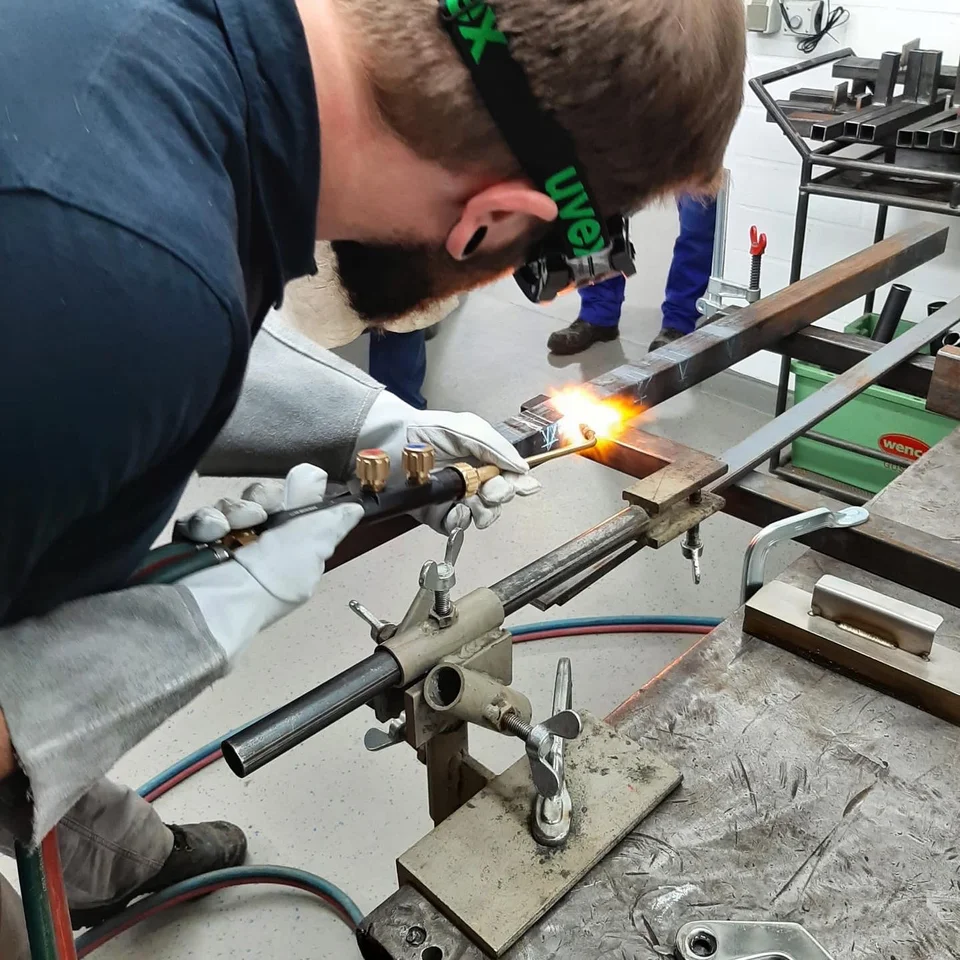
The aim of this practical training course is to impart the fundamental knowledge and skills in flux-cored welding. Participants learn how to select the appropriate flux-cored wire and how to set the corresponding welding parameters safely and efficiently. The focus is on the competent and safe execution of the welding process to achieve high-quality and durable welds.
Was vermittelt die Fülldraht-Schweißen-Schulung?
Die Schulung vermittelt die theoretischen Grundlagen des Fülldraht-Schweißens. Dabei liegt der Fokus auf der Auswahl des richtigen Fülldrahts sowie der korrekten Parametereinstellung. Es werden verschiedene Fülldrahtarten behandelt, um den Teilnehmern ein umfassendes Verständnis zu ermöglichen.
Welche Werkstoffe und Drahtarten stehen im Fokus?
In der Schulung werden niedrig- und hochlegierte Werkstoffe behandelt. Dabei kommen unterschiedliche Fülldrahtarten zum Einsatz:
- Rutil-Fülldraht
- Basischer Fülldraht
- Metallpulver-Fülldraht
Diese Auswahl ermöglicht es, verschiedene Schweißanforderungen abzudecken und die passenden Drahtarten entsprechend den Werkstoffeigenschaften auszuwählen.
Wer sollte an der Schulung Fülldraht-Schweißen teilnehmen?
Die Schulung Fülldraht-Schweißen richtet sich an:
- Schweißer
- Schweißaufsichtspersonal
Vorausgesetzt werden grundlegende Kenntnisse im Schweißen. Die Schulung ist besonders geeignet für Fachkräfte, die ihre Fähigkeiten im Bereich des Fülldraht-Schweißens erweitern und vertiefen möchten.
Was ist das Ziel der Schulung?
Das Ziel der Schulung Fülldraht-Schweißen ist die Vermittlung grundlegender Kenntnisse und Fähigkeiten im Bereich des Fülldraht-Schweißens. Die Teilnehmer sollen lernen, die verschiedenen Fülldrahtarten gezielt auszuwählen und die entsprechenden Schweißparameter sicher und effizient einzustellen. Der Fokus liegt auf einer kompetenten und sicheren Ausführung des Schweißprozesses.
Save the date
June 11, 2026
Start: 8:00 a.m.
Price
195 EUR plus VAT. (incl. lunch and certificate of participation)
Application Center Address
Ostring 16
34277 Fuldabrück-Bergshausen
Germany
Route
Training details at a glance
Date:
June 11, 2026, Start: 8:00 AM
Price
195 EUR plus VAT. (incl. lunch and certificate of participation)
Maximum number of participants:
15 people
Target group:
Welders and welding supervisors